VIDEO GAME screenshot
Last checked:
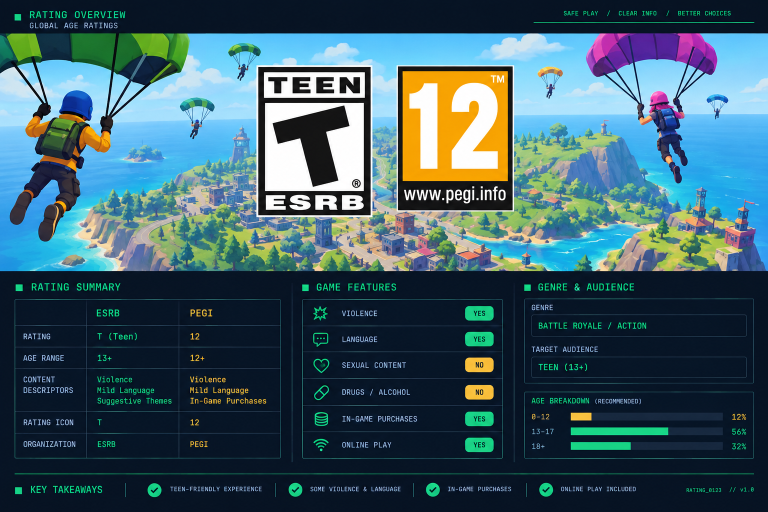
A video game content rating has two parts: an age category (ESRB E, E10+, T, M or AO in North America; PEGI 3 to 18 in Europe) and a set of content descriptors that state exactly why the game got that category. The category tells you who the game is suitable for. The descriptors tell you what you will actually see or hear, and a third layer, interactive elements, introduced in 2013 and extended to physical games in 2018, covers online chat, location sharing and in-game purchases. Here is what every label means, as of October 2026.
The three layers of a video game content rating
Every ESRB label on a box or store page stacks three things. Read them in this order and you get the full picture in about five seconds.
| Layer | What it answers | Where it appears | Example |
|---|---|---|---|
| Rating category | Who is the game suitable for? | Large letter on the front, left of the store rating box | T (Teen, 13+) |
| Content descriptors | Why did it get that category? | Text list on the back or in the store rating box | Blood, Language, Violence |
| Interactive elements | What can happen online that the rating does not cover? | Below the descriptors, often with its own line | Users Interact, In-Game Purchases |
Descriptors describe the shipped content. Interactive elements describe what other players and the publisher can add after launch: chat, user-generated content, microtransactions. ESRB keeps them separate because it cannot rate what strangers say in voice chat.
PEGI uses the same logic with a different vocabulary: an age number and a row of pictogram descriptors. Both systems are covered below.
ESRB rating categories
The Entertainment Software Rating Board assigns one of five age categories, plus a placeholder for unreleased games. The ages have not changed since the system launched in 1994, apart from E10+ being added in 2005.
| Category | Age guidance | Typical content | Retail enforcement (US) |
|---|---|---|---|
| E (Everyone) | All ages | Minimal cartoon or fantasy violence, infrequent mild language | None |
| E10+ (Everyone 10+) | 10 and older | More cartoon, fantasy or mild violence, mild language, minimal suggestive themes | None |
| T (Teen) | 13 and older | Violence, suggestive themes, crude humour, minimal blood, simulated gambling, infrequent strong language | None |
| M (Mature 17+) | 17 and older | Intense violence, blood and gore, sexual content, strong language | Voluntary ID checks by major retailers |
| AO (Adults Only 18+) | 18 and older | Prolonged intense violence, graphic sexual content, gambling with real currency | Not stocked by most retailers; not permitted on Nintendo, PlayStation or Xbox consoles |
| RP (Rating Pending) | Not yet assigned | Used in marketing before the final rating | Not for sale |
Since 2021 ESRB also issues RP (Likely Mature 17+) for pre-release marketing when the publisher expects an M. The final category can still change.
One point that trips people up: the ESRB rating is not a law. In the United States the ratings are voluntary industry self-regulation, enforced by retailer policy rather than statute. Walmart, GameStop and Target all require ID for M-rated purchases as store policy, and compliance checks run by the Federal Trade Commission have historically found game retailers refusing sales to minors at higher rates than cinemas or music stores.
All 30 ESRB content descriptors and what each means
ESRB publishes 30 descriptors as of October 2026. They are grouped below by the type of content they flag. The definitions are paraphrased from ESRB’s own glossary; the point of each is to tell you the intensity, not just the subject.
Violence descriptors
| Descriptor | What it means | Usually seen on |
|---|---|---|
| Cartoon Violence | Violent actions involving cartoon-like characters, often with no lasting harm | E, E10+ |
| Fantasy Violence | Violence in a fantasy setting, involving human or non-human characters, clearly separated from real life | E, E10+, T |
| Violence | Scenes involving aggressive conflict, which may include bloodless dismemberment | T, M |
| Intense Violence | Graphic and realistic-looking violence, which may involve extreme blood, gore, weapons and depictions of death | M, AO |
| Violent References | References to violent acts, without the acts being shown | E10+, T |
| Sexual Violence | Depictions of rape or other violent sexual acts | M, AO |
The ladder runs Cartoon, then Fantasy, then plain Violence, then Intense Violence. Each step up reflects realism and consequence rather than body count. A Mario game with Goombas being stomped gets Mild Cartoon Violence. A medieval RPG with sword combat usually lands on Violence or Intense Violence depending on how blood is handled.
Blood descriptors
| Descriptor | What it means |
|---|---|
| Animated Blood | Discoloured or unrealistic depictions of blood, such as green or stylised splashes |
| Blood | Depictions of blood |
| Blood and Gore | Depictions of blood or the mutilation of body parts |
Blood and Gore is the strongest of the three and almost always pairs with Intense Violence on an M. Blood on its own can appear on a T, which is why a game like Fortnite, which has no blood at all, sits at T with only Violence and the interactive elements. If you are checking the “fortnite age rating” for a younger player, the absence of a Blood descriptor is the detail that matters.
Language and humour descriptors
| Descriptor | What it means |
|---|---|
| Language | Mild to moderate use of profanity |
| Strong Language | Explicit or frequent use of profanity |
| Lyrics | Mild references to profanity, sexuality, violence, alcohol or drug use in music |
| Strong Lyrics | Explicit or frequent references to those same subjects in music |
| Comic Mischief | Depictions or dialogue involving slapstick or suggestive humour |
| Crude Humor | Depictions or dialogue involving vulgar antics, including bathroom humour |
| Mature Humor | Depictions or dialogue involving adult humour, including sexual references |
Lyrics descriptors apply only to music, which is why licensed soundtracks in sports and racing games frequently add Lyrics to an otherwise clean E rating. The three humour descriptors climb from Comic Mischief (slapstick) through Crude Humor (bodily functions) to Mature Humor (sexual jokes).
Sexual content and nudity descriptors
| Descriptor | What it means |
|---|---|
| Suggestive Themes | Mild provocative references or materials |
| Sexual Themes | References to sex or sexuality |
| Sexual Content | Non-explicit depictions of sexual behaviour, possibly including partial nudity |
| Strong Sexual Content | Explicit or frequent depictions of sexual behaviour, possibly including nudity |
| Partial Nudity | Brief or mild depictions of nudity |
| Nudity | Graphic or prolonged depictions of nudity |
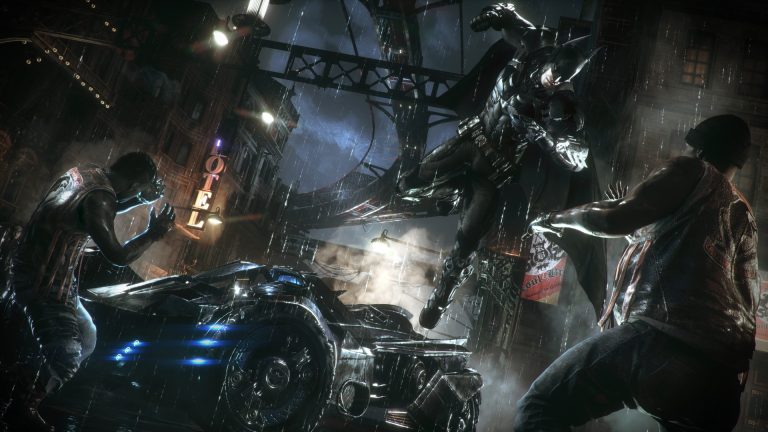
Suggestive Themes is the entry point and appears as low as E10+ for things like revealing costumes. It shows up on the “batman arkham knight rating” alongside Blood, Language and Violence, which together produce an M despite the game having no sexual content at all. Sexual Themes means the subject is discussed; Sexual Content means it is shown.
Substance descriptors
| Descriptor | What it means |
|---|---|
| Alcohol Reference | References to or images of alcoholic beverages |
| Drug Reference | References to or images of illegal drugs |
| Tobacco Reference | References to or images of tobacco products |
| Use of Alcohol | Consumption of alcoholic beverages |
| Use of Drugs | Consumption or use of illegal drugs |
| Use of Tobacco | Consumption of tobacco products |
The rule is simple: “Reference” means it appears or is mentioned, “Use of” means a character actually consumes it. A bar in the background earns Alcohol Reference. A playable character drinking earns Use of Alcohol. ESRB also combines these on labels when both apply, so you will see “Use of Drugs and Alcohol” written as a single line on Grand Theft Auto V.
Gambling descriptors
| Descriptor | What it means |
|---|---|
| Simulated Gambling | Player can gamble without betting or wagering real cash or currency |
| Real Gambling | Player can gamble, including betting or wagering real cash or currency |
Simulated Gambling covers casino minigames and slot machines that use in-game money. It is permitted on T and sometimes E10+. Real Gambling triggers AO automatically and is why no console game carries it.
The “Mild” qualifier
ESRB prefixes several descriptors with Mild to signal low frequency or intensity: Mild Blood, Mild Cartoon Violence, Mild Fantasy Violence, Mild Language, Mild Lyrics, Mild Suggestive Themes and Mild Violence are the ones you will see most. Mild is not a separate descriptor; it modifies one of the 30. A Mild Fantasy Violence label is what lets many Nintendo first-party games stay at E rather than E10+.
ESRB interactive elements
Interactive elements were introduced in 2013 for digital and mobile games, extended to physical releases in April 2018, and tell you what the rating category deliberately does not account for. There are five as of October 2026.
| Interactive element | What it means | Introduced |
|---|---|---|
| Users Interact | Players can communicate or exchange user-generated content with each other (text, voice, video, created levels) | 2018 |
| Shares Location | The game shares the player’s location with other users | 2018 |
| Unrestricted Internet | The game provides access to the internet, for example through a built-in browser | 2018 |
| In-Game Purchases | Offers the ability to buy digital goods or premiums with real money, including bonus levels, skins, music, virtual coins, season passes and subscriptions | 2018 |
| In-Game Purchases (Includes Random Items) | In-game purchases that include loot boxes, gacha, item packs, prize wheels or other mechanics where the player does not know what they are buying | 2020 |
Users Interact is the single most important line for parents. It appears on every online shooter and on sandbox games like Minecraft and Roblox, and it is the official way of saying the rating cannot vouch for what other people will type or say. It also tends to accompany games that support cross-platform gaming, since a bigger shared player pool means more unknown voices in the lobby.
The Random Items variant was added in April 2020 after sustained pressure over loot boxes. It applies to anything from Ultimate Team card packs in EA Sports titles to gacha pulls in free-to-play mobile games. The plain In-Game Purchases label means you can buy a known item at a known price.
PEGI content descriptors and ages
PEGI covers more than 35 European countries plus the UK. Instead of a text list it uses pictograms, and the age numbers are the actual recommended minimum age rather than a letter category.
| PEGI age | Meaning | UK legal status |
|---|---|---|
| PEGI 3 | Suitable for all ages; no sounds or pictures likely to frighten young children | Advisory |
| PEGI 7 | May contain scenes or sounds that frighten younger children; very mild implied violence | Advisory |
| PEGI 12 | Slightly more graphic violence toward fantasy characters, non-realistic violence toward humans, mild bad language | Legally enforced since 2012 |
| PEGI 16 | Realistic violence, sexual activity, strong language, use of tobacco, alcohol or drugs | Legally enforced |
| PEGI 18 | Gross violence, violence toward defenceless characters, sexual violence, glamorised drug use | Legally enforced |
PEGI uses eight content descriptors, each a black-and-white icon.
| PEGI descriptor | What it flags | Lowest age it can appear at |
|---|---|---|
| Violence | Depictions of violence | PEGI 7 |
| Bad Language | Use of bad language | PEGI 12 |
| Fear | Pictures or sounds likely to be scary or frightening | PEGI 7 |
| Gambling | Teaches or encourages gambling | PEGI 12 (PEGI 18 since 2020 for real-money simulation) |
| Sex | Sexual behaviour or references | PEGI 12 |
| Drugs | Use or reference to illegal drugs, alcohol or tobacco | PEGI 16 |
| Discrimination | Depictions of or material that may encourage discrimination | PEGI 18 |
| In-Game Purchases | Offers purchases with real money; a sub-text notes “Includes Random Items” since 2020 | Any |
The practical difference from ESRB: PEGI collapses the entire substance category into one Drugs icon and the entire violence ladder into one Violence icon, then uses the age number to carry the intensity. ESRB does the reverse, with broad age bands and precise descriptors. A PEGI 16 with the Violence icon and an ESRB T with Blood and Violence are often the same game.
Other systems you will see on store pages
Digital stores pull ratings from whichever body covers your region, so the same game shows different labels depending on where your account is registered.
| System | Region | Categories | Legally binding |
|---|---|---|---|
| ESRB | US, Canada, Mexico | E, E10+, T, M, AO | No (retailer policy) |
| PEGI | Europe, UK, Israel | 3, 7, 12, 16, 18 | Yes in UK (12+), Netherlands, others |
| USK | Germany | 0, 6, 12, 16, 18 | Yes |
| CERO | Japan | A, B, C, D, Z | Z (18+) legally restricted |
| ACB | Australia | G, PG, M, MA 15+, R 18+ | Yes (MA 15+ and R 18+) |
| GRAC | South Korea | All, 12, 15, 18 | Yes |
| IARC | Digital storefronts worldwide | Generates local ratings from a questionnaire | Follows the local system |
IARC matters more every year. Google Play, the Microsoft Store, Nintendo eShop, Oculus and parts of the PlayStation Store use an IARC questionnaire filled in by the developer, which then outputs an ESRB, PEGI, USK, ACB and ClassInd rating simultaneously. Steam does not require any rating at all, which is why many Steam pages show no age label.
How to read a video game content rating in five steps
What you need before you start:
- The game’s store page, box, or the ESRB or PEGI search site
- The age of the player you are checking for
- Two minutes
How to check a rating properly
- Find the age category first and compare it to the player’s age.
- Read every content descriptor, not just the first one.
- Note which descriptors carry a Mild prefix or a Strong prefix.
- Check the interactive elements line for Users Interact and In-Game Purchases.
- Open the rating summary on esrb.org for a two-paragraph description of specific scenes.
Expected result: you know the recommended minimum age, the three or four specific content types that drove it, and which online features the rating cannot cover. For an ESRB-rated game that takes about a minute with the summary; for PEGI, the pegi.info search gives the age and icons but shorter explanations.
Good to know
ESRB rating summaries, available for most physical console releases since 2008, quote actual lines of dialogue and describe specific scenes. They are far more useful than the descriptor list alone when two games share the same M label.
Common mistakes when reading ratings
Treating T as “fine for any teenager.” T spans a wide range. A sports game with Lyrics and a horror game with Blood, Violence and Suggestive Themes are both T. The descriptors are the whole point.
Ignoring Users Interact. Parents frequently approve an E10+ game like Minecraft and are surprised by voice chat. The age category never accounts for other players; only the interactive element does.
Assuming the rating covers DLC and updates. ESRB ratings apply to content at submission. Publishers must resubmit if an update adds content that would change the category, but minor additions within the same category do not trigger a new label.
Confusing PEGI numbers with ESRB letters. PEGI 12 and ESRB T (13+) look equivalent and usually are, but PEGI 16 can map to either T or M depending on the game. Check the local rating rather than translating.
Reading “Reference” as “Use.” Alcohol Reference and Use of Alcohol are different descriptors with different weight. The same split applies to drugs and tobacco.
Relying on Steam. Steam shows a rating only if the publisher supplies one. A blank rating box on Steam means nothing was submitted, not that the game is suitable for all ages.
FAQ
How many ESRB content descriptors are there?
ESRB lists 30 content descriptors as of October 2026, plus five interactive elements. The Mild prefix that appears on labels like Mild Fantasy Violence is a qualifier on one of the 30, not an extra descriptor.
What is the difference between a content descriptor and an interactive element?
A content descriptor describes what the publisher shipped: violence, language, blood, substances, sexual content, gambling. An interactive element describes what can happen online or through purchases after launch, such as Users Interact or In-Game Purchases. ESRB separates them because it cannot rate other players’ behaviour.
Are video game content ratings legally enforced?
It depends on the country. ESRB ratings in the United States are voluntary and enforced by retailer policy. PEGI 12, 16 and 18 are legally binding in the UK, and USK ratings are law in Germany. Australia’s MA 15+ and R 18+ and Japan’s CERO Z are also legally restricted.
Why does the same game have different ratings in different regions?
Each board has its own criteria. ESRB weighs realistic violence heavily, PEGI weighs fear and discrimination, USK historically weighed depictions of Nazi symbols, and Australia refused classification to some games before R 18+ was introduced in 2013. A game rated T in the US is often PEGI 16 in Europe and CERO D in Japan.
What does Rating Pending mean?
RP is a placeholder used in trailers and pre-order listings before ESRB assigns a final category. Since 2021 publishers can also use RP (Likely Mature 17+) to signal where they expect the rating to land. Games cannot ship at retail with an RP label.
Does an E rating mean the game has no online chat?
No. The age category and the Users Interact element are independent. A game can be E for content and still carry Users Interact, which means strangers can talk to the player. Always read the interactive elements line below the descriptors.
About the Author